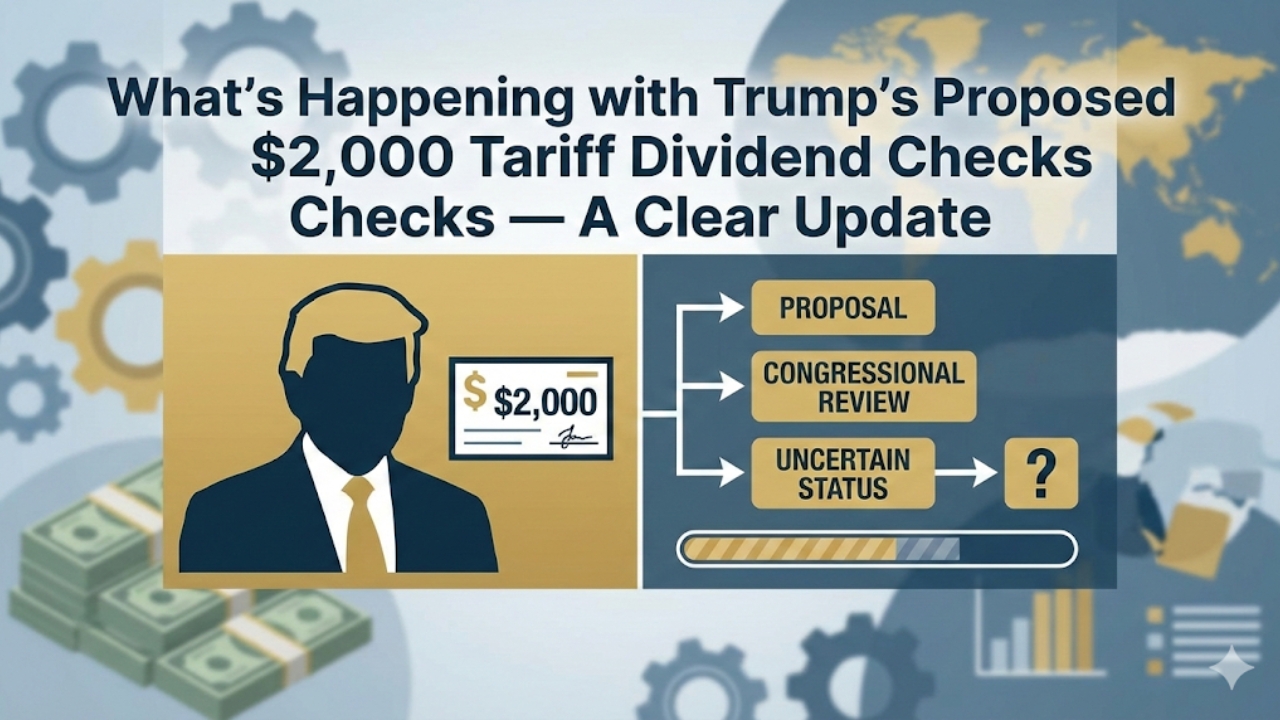
President Donald Trump has reignited discussions around his bold proposal for $2,000 tariff dividend checks, aiming to share tariff revenues directly with American families. As of early 2026, the idea remains a hot topic amid ongoing economic debates, though implementation faces hurdles.
Proposal Origins
Trump first floated the concept in mid-2025 on social media, touting tariffs as a way to fund direct payments without raising taxes on citizens. He argued that tariffs on imports, especially from countries like China and Mexico, generate massive revenue—over $600 billion by his January 2026 estimate—that could flow back to everyday Americans. The plan excludes high-income earners, mirroring past stimulus thresholds around $75,000 for individuals, positioning it as relief for the working class.
White House Stance
White House Press Secretary Karoline Leavitt affirmed in November 2025 that Trump is fully committed to the checks, with economic advisors actively exploring logistics. This followed Treasury Secretary Scott Bessent’s cautious remarks, where he suggested dividends might appear in various forms, like tax savings from Trump’s broader legislation. Despite mixed signals, Trump’s Truth Social posts keep the momentum alive, framing it as a win from his “America First” trade policies.
Revenue Realities
Tariffs imposed since Trump’s 2025 inauguration have indeed boosted federal coffers, targeting steel, electronics, and autos. Supporters claim this offsets inflation concerns, with stock markets and 401(k)s hitting records under low-inflation conditions. Critics, however, warn that businesses pass costs to consumers, potentially raising prices on goods by 10-20%. Here’s a breakdown of projected tariff impacts:
| Category | Estimated 2026 Revenue | Key Targeted Imports | Potential Consumer Cost Increase |
|---|---|---|---|
| China Goods | $300 billion | Electronics, apparel | 15% |
| Mexico/Canada | $150 billion | Autos, agriculture | 12% |
| EU Steel/Aluminum | $100 billion | Metals, machinery | 8% |
| Other | $50 billion | Various | 10% |
| Total | $600 billion | – | Avg. 11% |
This table draws from administration projections, highlighting how funds could theoretically support $2,000 checks for roughly 250 million eligible adults.
Political Hurdles
Congressional approval poses the biggest barrier, as dividend checks require legislation amid divided government dynamics. Democrats label it a gimmick, while some Republicans worry about deficit implications despite tariff offsets. Legal challenges from trade partners could delay revenues, and the IRS lacks clear guidance on distribution—direct deposits or paper checks remain undecided.
Economic Implications
If enacted, the checks could inject $500 billion into the economy, boosting spending on essentials amid steady growth. Economists debate long-term effects: proponents see it as fair profit-sharing from trade wins, akin to Alaska’s oil dividends. Detractors predict short-term stimulus followed by higher everyday costs, urging focus on wage growth instead.
Current Status Update
By February 2026, no bill has passed, but Trump hints at executive action or tying it to budget reconciliation. Fact-checks debunk viral rumors of imminent February payments, confirming it’s still in advisory stages. Watch for spring announcements, as tariff collections accelerate.
Public Reaction
Polls show 55-60% support among independents and Republicans, with enthusiasm highest in manufacturing states. Social media buzz amplifies Trump’s narrative of “fools against tariffs,” though urban voters express skepticism over price hikes. Families eagerly await clarity on eligibility and timelines.
FAQs
Will checks arrive by summer 2026?
Unlikely without swift congressional action; expect delays into late year.
Who qualifies for the $2,000?
Most adults earning under $75,000 individually, excluding top earners.
Are tariffs really funding this?
Yes, per White House claims, from over $600 billion in collections.
Disclaimer
The content is intended for informational purposes only. You can check official sources; our aim is to provide accurate information to all users.