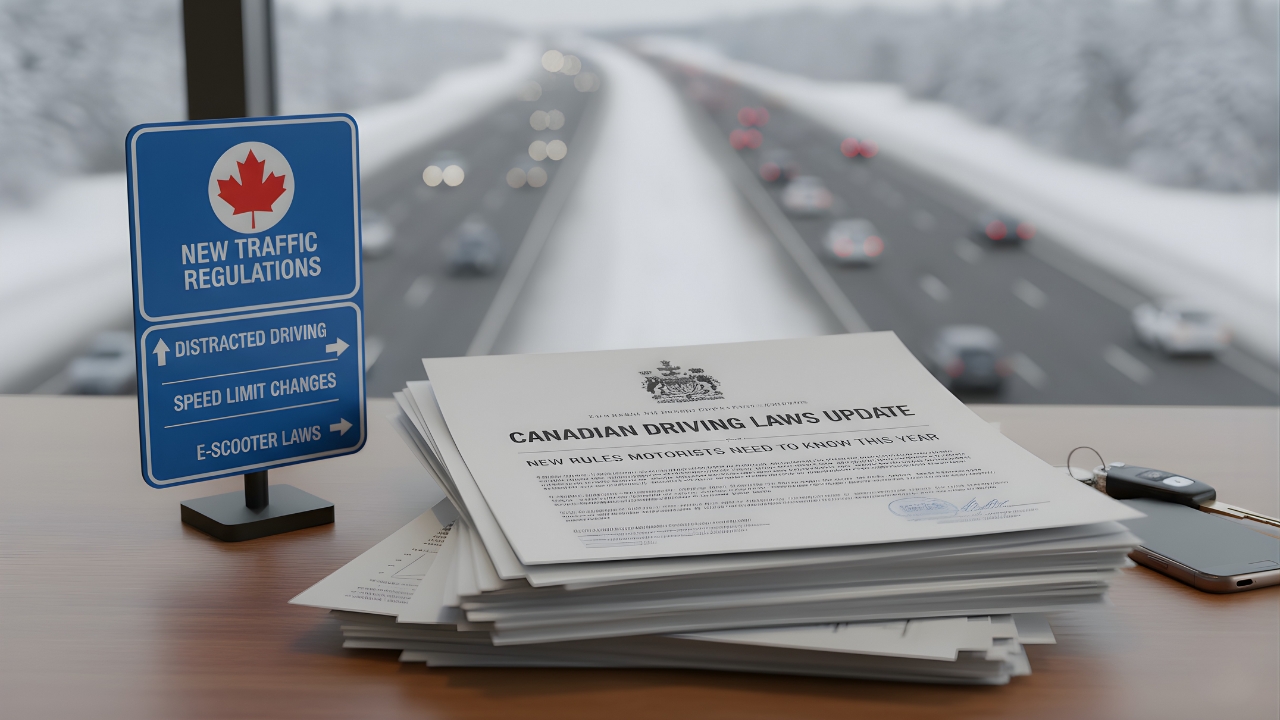
Canadian drivers are currently undergoing the most dramatic redefinition of road safety and licensing laws in decades. In collaboration with federal safety objectives, provincial governments have adopted an array of modifications that aim to reduce high risk behaviours and bring our transportation system to date with digital infrastructure. Being a newcomer to British Columbia or a long-standing driver in Ontario, it is crucial to know about these changes to ensure that you do not lose your ability to move freely and face the new rise of financial fines.
Modernization of Licensing: The Digital and Safer Testing
The most apparent modification in 2026 will be the implementation of Digital Driver’s Licenses (DDLs) in large provinces. These are phone-based credentials that are secure and can be used to verify the roadside instantly by the use of encrypted QR codes. In British Columbia, there has been a landmark reform, which has changed the program of Graduated Licensing Program (GLP) fundamentally. Beginning mid 2026, Novice (N) drivers with a clean 12 month record are no longer expected to undertake a second road test before being given a full Class 5 license. They will instead pass into probationary period which will focus on safe driving habits rather than the one-moment test.
Tougher Fines: the $1,000 and 2,000 Decrees
This year financial responsibility is at new levels. A uniform federal-provincial system has implemented a fine amounting to 1000 dollars as a minimum penalty on gravities such as distracted driving and non-yielding. In case of extreme violation, e.g. speeding (20 or more km/h above the limit), the fines might be as enormous as 2,000 dollars now. Moreover, Ontario has increased its policy of zero-tolerance. The zero-tolerance policy on alcohol and cannabis is no longer exclusive to novice drivers and commercial drivers and applies to all drivers under the age of 21 with populations of immediate immediate roadside suspension and mandatory education programs on violations.
The Elderly Drivers: Improved Medical and Cognitive Review
In the case of drivers aged 75 years and above, 2026 will be the onset of more elaborate health examination. New Medical Fitness rules dictate that seniors in this age group have to pass through increased vision and cognitive tests during their renewal of the licenses. These tests have become commonplace in Alberta and Ontario, and are usually done every 2 years after a driver turns 80. This is not aimed at eliminating licenses on the basis of age, but on the premise of detecting conditions such as slow reactionary times or loss of sight beforehand and ensuring safe drivers can be allowed to remain on the road without jeopardizing the safety of the populace by issuing conditional or restricted licenses where applicable.
Vehicle Safety and Theft Protection Mandates
Technically, the Transport Canada has amended the Motor Vehicle Safety Regulations in its fight against the increased high-tech auto theft. Immediately, the automobiles imported or sold in Canada in 2026 will have to be of modernized standards in immobilization which will be resistant to the electronic attack tools. Also, the federal government is trending on the requirement of Advanced Driving Assistance Systems (ADAS), including automatic emergency braking, as a standard component. This is in line with the 2026 Auto Strategy which also aims at standardizing EV charging etiquette and defensive driving units in adverse weather caused by climate.
In Perspective: Interprovincial Standardization
The most demanded changes such as standardization among provinces are finally establishing themselves. Previously, transfers between provinces used to be a disorienting experience of a patchwork of rules to follow. By 2026, unified road test requirements are going to be implemented in most provinces in Class 5 licenses. This harmonization provides that there is a greater conformity to the record and demerit points of a driver between provincial jurisdictions, eliminating the opportunities of repeat offenders. Now, with the conditions getting further into the year, it has never been more important to keep your digital profile updated and your driving history in a clean state in terms of both your financial and legal well-being.
Canadian driving statistics summary 2026
| Violation / Change | Previous Average | 2026 New Standard |
| Excessive Speeding Fine | Up to $500 | Up to $2,000 |
| Distracted Driving Fine | $300 – $500 | **$1,000+** |
| Senior Renewal Period (80+) | 2–5 Years | 1–2 Years (Tiered) |
| Digital ID Availability | Pilot Phase | Nationwide Rollout |
Frequently Asked Questions (FAQs)
1. The second road test in BC is not passed by all?
No. The elimination of Class 5 road test is only applicable to those under the BC Graduated Licensing Program whose record of the Novice (N) licence is clean. International drivers of the non-reciprocal countries also should take the road test.
2. What will happen to me in case I get a phone at a red light?
Even a stoplight device-holding is a primary offense under the new 2026 enforcement. This attracts a fine of 1,000 dollars along with a 3 days license suspension among repeat offenders in most provinces.
3. Is my physical driver license still good?
Yes. Although the usage of digital IDs is being promoted due to their convenience and safety, plastic cards are still considered legal in the country, and one will need to travel abroad with them.
Disclaimer
The material is purely informational. you may refer to the official sources by Transport Canada or Ontario Ministry of Transportation our intention is to make all the users aware of the correctly represented information.