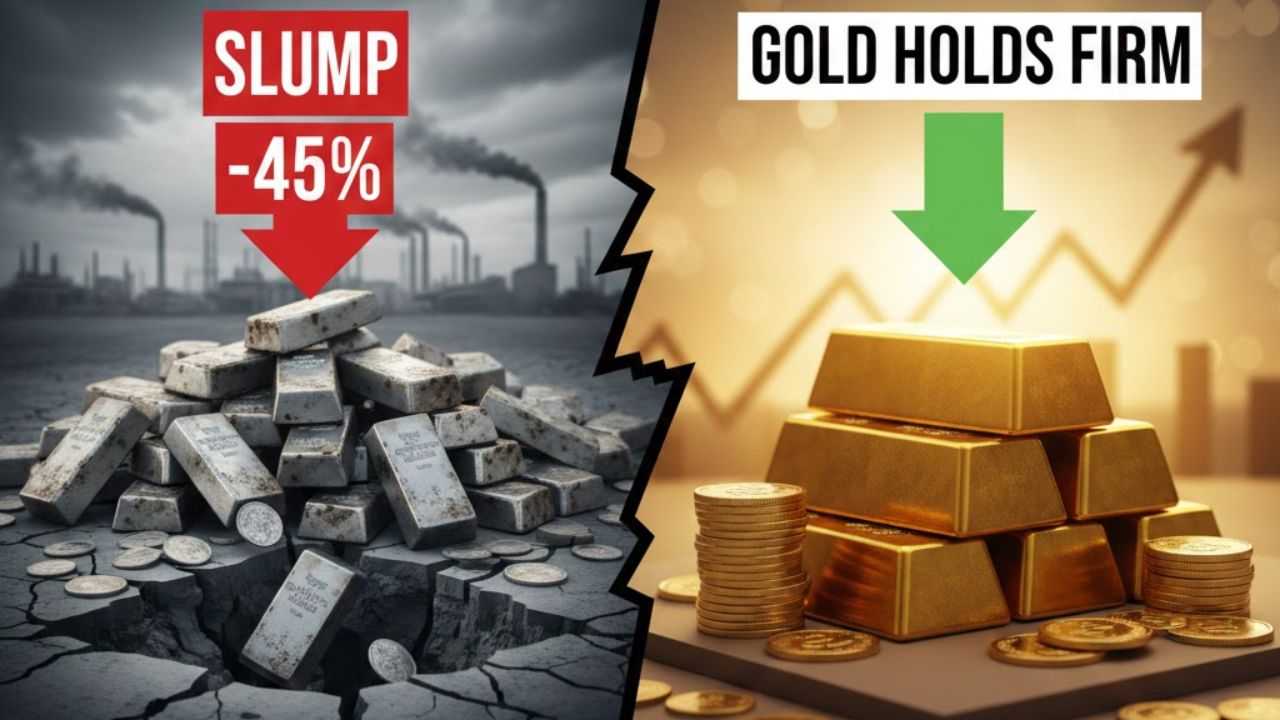
The global financial markets recently witnessed a seismic shift as silver, often dubbed “gold on steroids,” lived up to its reputation for extreme volatility. In a staggering downturn, silver prices plummeted by approximately 45% from their January 2026 peaks, leaving many retail and institutional investors in a state of shock. Meanwhile, gold, the perennial safe-haven anchor, showed remarkable resilience, holding its ground with significantly lower losses. This divergence between the two most prominent precious metals has sparked a debate among analysts: is this a fundamental collapse or merely a violent flushing of market “froth”?
The Mechanics of the 2026 Silver Crash
The primary catalyst behind silver’s 45% plunge was a classic “liquidity event” amplified by technical triggers. In late January 2026, silver had reached historic highs, driven by a combination of industrial demand for AI infrastructure and speculative “long” positions. However, as the U.S. Dollar Index (DXY) strengthened following the nomination of Kevin Warsh as the next Federal Reserve Chairman—a move markets interpreted as hawkish—the tide turned. Because silver’s market is smaller and less liquid than gold’s, the initial sell-off triggered a cascade of margin calls and stop-loss orders, accelerating the downward spiral far beyond what fundamentals suggested.
Gold vs. Silver: A Tale of Two Metals
While silver was bleeding value, gold acted as a stabilizing force in many portfolios. The yellow metal’s primary role as a hedge against currency debasement and geopolitical tension kept it relatively firm. Unlike silver, which derives nearly half of its value from industrial applications like solar panels and electronics, gold is almost purely a monetary asset. When global economic uncertainty spikes, investors flock to gold for safety, whereas silver’s industrial exposure makes it vulnerable to fears of a cooling manufacturing sector. This fundamental difference explains why gold experienced a modest correction while silver faced a historic crash.
Comparative Performance Data: Gold vs. Silver (Early 2026)
| Metric | Gold (XAU) | Silver (XAG) |
| Peak Price (Jan 2026) | ~$5,600 / oz | ~$121 / oz |
| Current Price (Feb 2026) | ~$4,800 / oz | ~$73 / oz |
| Total Percentage Drop | ~14-17% | ~40-45% |
| Market Volatility (Beta) | Moderate | High |
| Primary Driver | Monetary Hedge | Industrial + Speculative |
Why Speculative Froth Fueled the Fire
By the end of 2025 and into early 2026, silver had become a “crowded trade.” Many traders had entered the market with high leverage, betting on a perpetual supply deficit. When the price failed to break further upward in February, these leveraged positions were forced to unwind. In the world of commodities, when everyone is leaning on one side of the boat, even a small wave can capsize the vessel. This 45% slump represents a massive deleveraging phase, effectively resetting the market and removing short-term speculators who were chasing the “parabolic” gains of the previous months.
The Role of Industrial Demand and AI
A significant factor in silver’s long-term outlook is its critical role in the green energy transition and the booming Artificial Intelligence sector. Silver is the most conductive metal on Earth, making it indispensable for high-speed data centers and advanced computing chips. Despite the recent price crash, the underlying industrial demand remains robust. Analysts note that the current price dip may actually be a blessing for industrial consumers who were struggling with the skyrocketing costs of raw materials. For long-term investors, the disconnect between the crashing price and the steady industrial need creates a unique “value” window.
Navigating the Gold-to-Silver Ratio
The Gold-to-Silver Ratio is a key metric used by savvy investors to determine which metal is relatively “cheap.” Before the crash, the ratio had compressed significantly as silver outperformed gold. Following the slump, the ratio has widened again, crossing the 60:1 mark. Historically, when this ratio expands rapidly, it indicates that silver is oversold relative to gold. Many contrarian investors use these wide-ratio periods to rotate capital from gold back into silver, anticipating a “mean reversion” where silver eventually catches up during the next bull cycle.
Strategic Takeaways for Investors
For the average investor, this sharp price movement serves as a reminder that position sizing is critical. Silver’s 45% drop highlights the risks of over-allocating to highly volatile assets. Most financial advisors recommend treated silver as a satellite holding—a high-reward addition to a core portfolio of more stable assets like gold or equities. Rather than panicking and selling at the bottom, disciplined investors often use “staggered buying” or dollar-cost averaging to build positions during such corrections, effectively lowering their average entry price while waiting for the market to stabilize.
Looking Ahead: Will Silver Rebound?
While the short-term outlook remains “choppy” as the market digests the recent volatility, the structural bull case for precious metals is far from over. Central banks continue to diversify away from the dollar, and global debt levels remain at record highs. As the “dust settles” from the February 2026 crash, the focus will likely shift back to silver’s supply deficit. With mining output struggling to keep pace with the demands of the modern tech economy, many experts believe that once the speculative froth is gone, silver will begin a more sustainable, fundamental-driven climb back toward its previous highs.
FAQs
Q1 Why did silver fall so much more than gold?
Silver is a much smaller and less liquid market. It also has an industrial component that makes it sensitive to economic growth forecasts, whereas gold is primarily a safe-haven asset.
Q2 Is it a good time to buy silver now?
While prices are significantly lower, the market remains volatile. Many analysts suggest a “wait and see” approach or using small, staggered purchases to mitigate the risk of further short-term dips.
Q3 How does the U.S. Dollar affect these prices?
Precious metals are priced in dollars. When the dollar gets stronger (as it did recently), it makes gold and silver more expensive for international buyers, which typically pushes prices down.
Disclaimer
The content is intended for informational purposes only. you can check the officially sources our aim is to provide accurate information to all users.