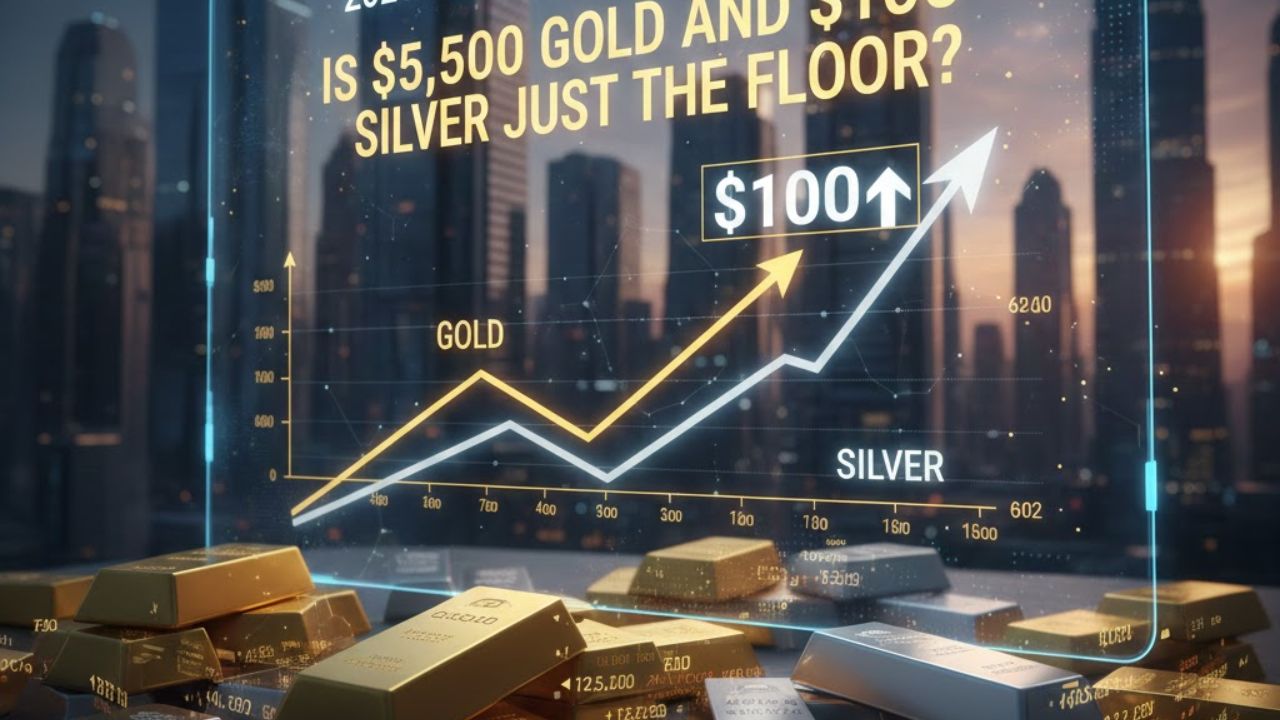
The landscape of global finance has shifted dramatically as we move through 2026, with precious metals shedding their reputation as “sleepy” assets to become the primary drivers of market momentum. For decades, investors viewed gold and silver through the lens of cautious wealth preservation. However, the current economic climate—defined by record-breaking sovereign debt, persistent currency debasement, and aggressive central bank accumulation—has pushed these metals into a parabolic bull run. With gold recently breaching the $5,500 mark and silver eyeing the triple-digit milestone of $100, the conversation has moved past whether these prices are sustainable to whether they represent a new permanent floor for the decade.
The Multi-Polar World and Central Bank Hunger
One of the most significant catalysts behind the $5,500 gold narrative is the fundamental shift in how global central banks manage their reserves. No longer content with holding vast quantities of fiat-based debt, emerging market economies have transitioned into “conviction buyers.” In early 2026, data suggests that central bank gold purchases are on track to remain at elevated levels, as nations seek to de-risk from the U.S. dollar. This structural demand creates a “hard floor” beneath the price; every time a correction occurs, institutional buyers step in to diversify their portfolios, preventing the deep crashes seen in previous cycles. This institutional backing is the primary reason analysts believe $5,500 is not a peak, but a psychological base for the next leg up.
Silver’s Industrial Revolution and Supply Deficits
While gold captures the headlines, silver is arguably the more explosive story of 2026. Silver’s dual identity as both a monetary asset and a critical industrial component has led to a perfect storm of demand. The global push for green energy—specifically in the manufacturing of electric vehicle (EV) components, solar panels, and high-tech AI hardware—has resulted in a sixth consecutive year of structural supply deficits. Mining output simply cannot keep pace with the frantic rate of industrial consumption. When you combine this “industrial squeeze” with the fact that silver has historically been undervalued relative to gold, the path toward $100 an ounce seems not just possible, but mathematically probable.
Market Comparison: 2026 Forecasts at a Glance
| Metal Type | 2026 Conservative Target | 2026 Bull Case Target | Primary Growth Driver |
| Gold | $4,800 – $5,000 | $6,300+ | Central Bank Buying & Debt Hedging |
| Silver | $75 – $85 | $125 – $200 | Industrial Deficit & Green Tech |
| Platinum | $1,800 | $2,500 | Hydrogen Economy & Supply Tightness |
Currency Debasement and the “Real Asset” Rotation
The broader “debasement trade” is the invisible hand pushing precious metals higher in 2026. As global debt levels reach unprecedented proportions, investors are losing faith in the long-term purchasing power of paper currencies. This has triggered a massive rotation of capital out of traditional bonds and into “hard assets.” In this environment, gold and silver act as the ultimate insurance policy. Unlike fiat currency, which can be printed in unlimited quantities, the physical scarcity of gold and silver provides a sanctuary for capital during times of monetary experimentation. As long as fiscal deficits continue to expand, the upward pressure on metals is likely to persist.
Geopolitical Tension as a Volatility Catalyst
2026 has been marked by a series of geopolitical “shocks” that have sent traders scurrying for safe-haven assets. From trade tariff wars to shifting military alliances, the fragility of the global supply chain has made “calm” a rare commodity in the markets. Gold thrives on this uncertainty. Whenever a new diplomatic crisis hits the news cycle, we see immediate “limit up” moves in the futures markets. While this leads to high volatility and occasional sharp pullbacks, the long-term trend remains firmly bullish because the underlying tensions show no signs of a permanent resolution. For the modern investor, holding metals has become less about speculation and more about survival in a turbulent world.
Technical Analysis: Breaking the Psychological Barriers
From a technical standpoint, the recent price action has invalidated many traditional bearish models. Gold’s ability to reclaim the $5,000 level after brief corrections signals that there is massive “dip-buying” conviction in the market. Similarly, silver’s move past the $80 resistance zone has entered what traders call “price discovery” territory, where there is very little historical overhead resistance to stop a run toward $100. Analysts note that as long as the metals stay above their 50-day moving averages, the “trend is your friend.” The sheer volume of ETF inflows in early 2026 confirms that both retail and institutional players are now chasing the rally, adding further momentum to the fire.
Conclusion: Is the Top in Sight?
As we look toward the remainder of 2026, the evidence suggests that the rally in precious metals is far from over. While $5,500 gold and $100 silver were once considered “conspiracy theory” targets, they are now the reality of our current economic paradigm. The combination of central bank de-dollarization, industrial silver shortages, and a global flight to safety has created a “super-cycle” that could last for years. While short-term volatility will always be part of the game, the fundamental drivers—debt, deficit, and demand—are stronger than ever. For those watching from the sidelines, the question is no longer “is it too high?” but “how much higher can it go?”
FAQs
Q1. Why is silver rising faster than gold in 2026?
Silver is benefiting from a “double-demand” scenario. It is being bought as a safe-haven asset like gold, but it also faces a massive supply shortage due to its essential role in green technologies like solar panels and electric vehicles.
Q2. Is $5,500 gold a sustainable price floor?
Many experts believe so, primarily because central banks are now consistent buyers. Their need to diversify away from fiat currencies creates a massive level of support that prevents prices from crashing back to previous decade levels.
Q3. What are the biggest risks to this bull market?
The main risks include a surprise move by central banks to sharply raise interest rates or a sudden resolution to major geopolitical conflicts, which could temporarily reduce the demand for safe-haven assets.
Disclaimer
The content is intended for informational purposes only. you can check the officially sources our aim is to provide accurate information to all users